Builder Quotes: Compare Costs Without the Chasing
Most homeowners request builder quotes, wait weeks for responses, then receive documents so different in structure that they are nearly impossible to compare.
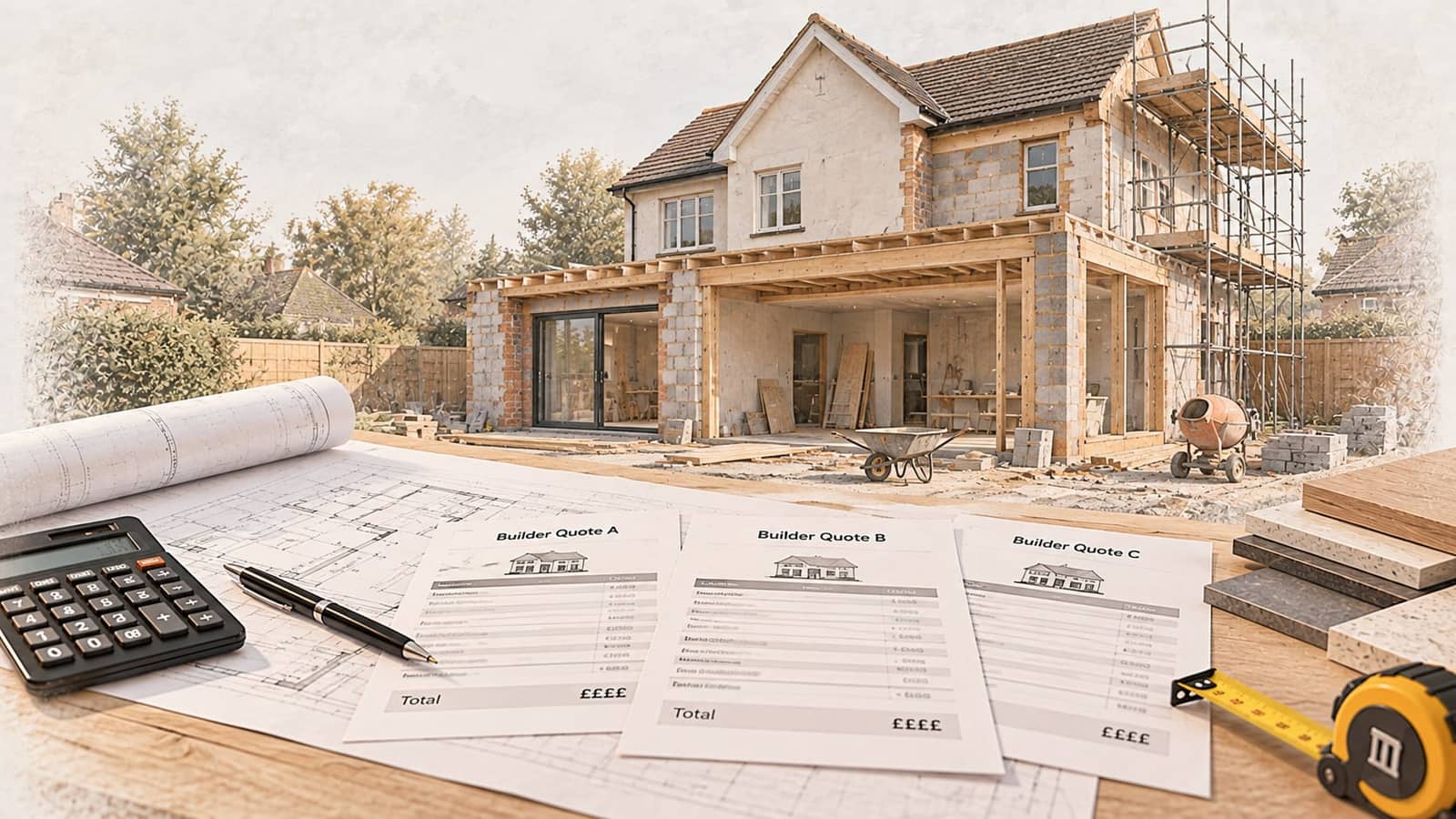
This guide explains what a proper builders quote should include, how to read one accurately and what to watch for before signing anything. Compare Builders is built to make that process shorter and considerably less frustrating.
How Builder Quotes Should Work
A builder quote is a written document setting out a defined scope of work at a stated price. It should include labour, materials or allowances, VAT treatment, a programme, payment stages, provisional sums and a clear list of exclusions.
An estimate is something different. It is less fixed, less detailed and should always be labelled as such. Never compare a detailed quote from one contractor with a one-line total from another. That comparison tells you very little.
Ask every contractor to price the same written scope. Identify any provisional sums, these are allowances for work that cannot be fully priced at the outset. Clear paperwork now means fewer arguments later.
What Should a Builder Quote Include?
A well-structured document covers the following:
- Scope of work : a description of exactly what is being built or installed
- Labour costs : either itemised or included in a total
- Materials : specified products, brands or allowances where exact items are not yet confirmed
- VAT : stated clearly as included or excluded
- Programme : expected start date, duration and key milestones
- Payment stages : when each payment is due and what it covers
- Provisional sums : clearly labelled allowances for uncertain elements
- Exclusions : what the contractor is not responsible for delivering
- Variation process : how changes to scope will be agreed and priced
If any of these are absent, ask before you proceed. A contractor who cannot provide a structured document may not manage the build with any more clarity either.
Quote vs Estimate: What Is the Difference?
A quote is a fixed price for a defined scope, subject to the terms, assumptions and exclusions set out in the document. If the scope does not change, the price would generally not change. A building quote provides a firmer basis for comparison than a rough estimate, although its legal effect depends on the terms and circumstances of the agreement.
An estimate is indicative. It may shift as the project develops or as more information becomes available. Some contractors use the terms interchangeably. They should not. Always ask: is this a fixed quote or an estimate?
For any project above a few thousand pounds, request a written quote. Verbal agreements can be difficult to enforce if the relationship breaks down.
How Many Builder Quotes Should You Get?
Three is a common recommendation. Two gives limited comparison. Four or more can produce confusion rather than clarity, particularly when the documents vary widely in structure.
Getting builder quotes from three contractors based on the same written brief gives you a meaningful range. It also tells you which contractors have read the brief carefully and which have not.
If one quote comes in significantly below the others, treat that as a signal to investigate rather than a reason to celebrate. A substantial difference can indicate that something is missing from the scope, specification or programme.
How to Compare Builder Quotes Properly, Not Just on Price
Lay the documents side by side. Do not start with price. Start with scope.
Do the quotes cover the same work? If one contractor has excluded groundworks or finishing trades, the total is not comparable. Identify every exclusion in each document before looking at the bottom line.
Are provisional sums consistent? If one quote allows £3,000 for kitchen units and another allows £8,000, the difference is not simply a profit margin. It reflects a different assumption about what you want.
Is VAT included? A quote excluding VAT on a £50,000 project would be £60,000 if the standard 20% VAT rate applies. Always confirm VAT treatment before comparison.
Are payment stages reasonable? Stage payments tied to completed milestones are standard practice. Agree the payment schedule clearly before work starts, and avoid making large upfront payments without understanding what they cover.
To compare builder quotes effectively, create a simple spreadsheet. List each contractor across the top. Row by row, record how each document handles scope, VAT, exclusions, programme and payment terms. Price becomes one row among many, not the only one.
Why the Cheapest Quote Is Not Always the Best
A common misconception about UK builder quotes is that the best deal is simply the lowest submission. However, the lowest quote does not always cover the same scope as the mid-range options. When a local contractor quotes £22,000 for a full loft conversion while three others come in at £38,000 to £45,000 for the same property, the cheap quote may be missing something material. That missing element can then appear as an additional cost mid-build.
This matters because the final cost of a project is not necessarily the number on the quote. It is the quote plus variations, any work excluded and later required, and any delays caused by inadequate planning.
As a practical reference for 2026, a standard single-storey rear extension in England can typically run from £2,000 to £3,000 per m² including VAT for a complete build, excluding design, surveys and abnormal works. A quote significantly below that range warrants scrutiny.
The cheapest contractor is occasionally the right choice. More often, the best value sits in the middle of the range: properly scoped, clearly documented and from a contractor with a verifiable track record.
Red Flags in a Builder Quote
These are signs worth investigating before you commit:
A single unexplained total. No breakdown, no exclusions listed and no payment stages. This is not enough information to make a meaningful comparison.
No VAT treatment stated. Ask directly. Ambiguity here can add 20% to the final bill where the standard VAT rate applies.
A large deposit requested upfront. A sizeable payment before work begins deserves particular scrutiny. Ask what the money covers, when materials will be ordered and whether any deposit protection is available. Avoid committing a large proportion of the project cost before work has begun.
No written programme. A contractor who cannot say when they expect to start or how long the work is likely to take is worth questioning.
Pressure to sign quickly. Legitimate contractors should give you reasonable time to review documents, insurance and references rather than pressuring you to decide within 24 hours.
Vague exclusions. "All other works not listed" is not a useful exclusion. It leaves too much open to interpretation. Exclusions should be specific and itemised.
Why Vetted Builders Give You More to Check
Price is only one part of deciding who should quote for your project. Compare Builders uses a defined verification process before a trade is shown to a homeowner. These checks are repeated rather than treated as a one-off exercise.
The eight checks cover Companies House status; public liability insurance; VAT registration; trade body membership cross-referenced against the relevant Gas Safe, TrustMark, NICEIC, FENSA, FMB and NHBC registers; reputation and the Trust Portfolio; right to work; photo ID with a liveness check; and financial standing.
This gives homeowners more information when comparing builders. Verification does not remove the need to read the quotation, check the proposed scope or satisfy yourself that the appointed trade is suitable for the work.
How Compare Builders Works
Compare Builders matches homeowners with verified tradespeople based on the project submitted. Interested builders put themselves forward, and the homeowner chooses three verified builders to quote. The quotations can then be compared against the same project requirements rather than relying on a stream of unsolicited responses.
Every trade shown to a homeowner has already been through the eight checks and is rechecked periodically. The Trust Portfolio helps homeowners assess verified builders based on their verification depth, reviewed work and track record.
Before appointing anyone, review the full quote, current insurance documents, references and the contract. Those steps remain yours to carry out.
Set your budget before you start comparing figures. The Cost Planner provides an indicative range based on your project details and postcode area, giving you a useful benchmark before you assess individual quotations.
You describe the project, choose three verified builders from those interested in it, and compare three quotations side by side. It is free for homeowners.
Compare Builders introduces homeowners to verified trades. The contract for the work is between you and the trade you appoint.
Ready to compare builder quotes without the chasing? Use the Cost Planner to set your budget, then start your project with Compare Builders and choose three verified builders to quote.
Builder Quote FAQs
Can a builder change a quote once I have accepted it?
A fixed quote should not change unless the scope changes or the agreed terms allow for an adjustment. If variations arise, such as unforeseen groundwork issues, they should be agreed in writing before the additional work proceeds.
Should I pay a deposit before work starts?
A modest deposit may be requested, but the amount and purpose should be clear before you agree to it. Ask for a receipt and understand what the payment covers. Avoid paying large sums before work is under way.
What if two building quotes differ by more than 30%?
Go back to both contractors. Ask each to walk through their assumptions. The gap usually comes from different scope assumptions, different material allowances or one contractor missing something. It is rarely simply one contractor being more generous.
Do I need a contract as well as a quote?
Yes. A quote sets out price and scope. A contract sets out rights, responsibilities and what happens if things go wrong. For any project above a few thousand pounds, a written contract is worth having.
How long should a builder's quote remain valid?
The validity period depends on the contractor and the terms of the quotation. Many quotes specify a period such as 30 to 60 days because material costs can change and contractors cannot hold prices indefinitely. If your project is delayed, ask for a refreshed document before you commit.